Welcome to My Blog!

New readers can click here to learn more about the contents and mission of this blog.

Showing posts with label writing. Show all posts

February 17, 2011

Getting to Know Your Story - Part II

In a previous post I talked about the notions of idea versus story, and last time I discussed the importance of doing research--aka learning.

You cannot hope to understand your story if you don't even know what is supposed to go into one in the first place.  You cannot write a good novel without having basic knowledge of storytelling elements beforehand.  Trust me, that lack of knowledge will pop up later as some glaring weakness in your writing you hadn't really noticed before, which means you'll have to stop writing, go investigate the problem and then learn about it when all you want to do is write the darn thing.  At least if you've done the research first you'll know how to spot those weaknesses when they do manifest.  More importantly, you'll know how to fix your own problems.  (There's that do-it-yourself aspect again...)

Most of them, anyway.  The rest is for first readers and editors to catch.  But we haven't gotten that far yet.

Today, I am going to use my experience writing a novel to provide some examples of methods and techniques you can use to help you start fleshing out that vague, nebulous idea into what will eventually, hopefully, become an actual story.  A completed first draft.  Perhaps even a novel worth reading.  (Though, who knows?  You may discover your idea isn't large enough for a novel but instead is more suited to a short story or novella.  No one length is better or worse than the others.  I just happen to know I'm writing a novel-length tale, so my blogs are going to naturally reflect this.)

NOW, *ehem* to the point.

Even while you're learning about the basics of storytelling, you can begin exploring your new story idea.  Looking back on my experience thus far, there are a couple of things I wish I would have done differently before I decided I was writing the actual novel.  Doing more research about writing is one of them.  (And you may get sick of hearing it, but I can't stress it enough.)

I did it backwards.  I explored my ideas some, started writing the novel, and then went back to learn more about the basic elements of storytelling--concept, character, plot, theme...those things.  (I also see setting mentioned as one, but really you can view your setting as another character.  Some people also list conflict as a basic element, but your plot should already include that after it's been planned/figured out or else you'll put readers to sleep.  Larry Brooks also lists scene construction and writing voice, or style, as "executional competencies."  I think scenes belong to the larger plot, but they certainly do merit their own discussion.  However, style isn't such a basic thing and doesn't emerge until you've written a good number of words, so let's not go there just yet.)

The other thing, I think, has to do with the discovery process of figuring out what story you want to tell.  I don't believe a story just magically comes to you all wrapped up in a pretty pink bow saying, "I grant you the power of omniscient knowledge and artistic insight.  Now go, aspiring writer--write!"  Though, that would be pretty awesome.

What does happen is this: Your mind is captivated by some vague-ish idea, be it a thought, a character, a setting or some other element of a story, and it grabs hold of you like a...well, I don't know what.  But you can't shake it because it's determined that you, lucky you, become its voice.

Unnecessary mysticism?  Perhaps, but for lack of any other way to describe the phenomenon, that is exactly how I feel about it.

Exploring Your Idea

If you can't just walk away from something like this and are suddenly inspired to become a writer (Lord help you), then what you have to do at that point is explore this thing, this vague idea that's spontaneously come to you.  What is it, exactly?  (Idea, concept, or story?)  What does it want to become? (A short story?  A novella, a novel?  Something epic?)  What, if anything, does it have to say?  Hmm...

More directly, what do you want to say?  Why?  (More on this another time; it's something I'm still exploring, more or less, as well.)

Perhaps you're the kind of person that is really good at coming up with a clear plan, implementing it and sticking to it.  You come up with a story idea; you outline your setting(s), character bios, and plot(s) and develop a premise;  you are blessed with a clear vision of what your novel is going to be about after some effort; and then you're on your merry way writing the thing.

I'm not that kind of writer.  I think I have to take a more organic approach, and by that I mean I can't just sit around thinking about things for them to "come" to me.  I have to sort of muck around first and make connections between things that aren't even necessarily related to one other before I come up with something that would work for a novel; the premise and the story itself have to kind of morph out of a collection of broad ideas that I feel should go together but, at the time being, don't mix well logically.

It's like pulling select things out of the vast aether and trying to make sense of it all.

It's like a giant puzzle, in my mind.  I've got the pieces (some of them, at least); now I just need to figure out how to put them together.  Or if I'm still missing pieces (plot holes, lack of character development, etc.).  Or if I have extra pieces (ideas that come to you but don't necessarily work for the story or novel you're currently working on.)

The organic process takes time, but that's how I have to do things and I'm cool with that.

The moral of that short story: I don't know what kind of writer you are; you'll have to figure that out for yourself.  What I can do is share some suggestions on how you might go about discovering your story and come up with some preliminary plans.  (I say preliminary because those initial plans are bound to change, in one way or another.)

Just write.

Remember at the beginning I talked about what the first step might be after you've been bitten by the muse--aka got an idea?  I suggested you start writing about it.

Yes and no.

No, don't start writing the novel just yet.  Yes, do start writing something creative.  Something that has to do with your new infant idea.  (As they say, you can't be a writer if you don't, after all, write.  They also say you may go through a million rotten ideas before you get to a nice shiny one.  I wholeheartedly believe both are true.)

What I mean is, if you've never written a novel before, don't put yourself in the mindset of "okay, I'm writing a novel now" right off the bat.  Set out to explore your idea a bit.  Get chummy.  Get to know one another.  Some of your ideas may even insist that you know yourself a little better before you get try to get to know them.  *snap-snap-snap* Okaaayy?  (Black humor there.)  Your muse/subconscious can be self-righteous and sassy like that.

When I thought I was writing a novel, when I went through the entitled "Seven and a Half First Drafts," I believe that what I was actually doing was making small attempts at scenes.  Perhaps some short stories.  The problem was I didn't have a clear end goal in mind, no overarching plot to provide a sense of purpose.  The scenes had conflict and were connected through character and setting, but the overall plot was vague, undecided.

So I suppose I did gain some practice in this way.  (I also participated in some online role-playing at one Star Wars community for several years, but that is quite another story...)

Writing Tools

One of the ways you can "get to know" your novel before you start writing it is by keeping a writer's journal.  You wouldn't believe how many journals I've kept on my WIP (work in progress, from here on out).  Not only do I keep a paper-and-pen journal--you know, the old school kind--but also a word processor journal because sometimes thoughts come to you when you least expect.

I always include the date of entry and give it a title.  This helps to set a writing goal, something to write towards.  If I want to explore a certain character, for example, then I name that entry something like "Voi's Character."  Or, if I'm exploring more than one thing, I'll link several titles together, like "Voi's Character; Elementalism."  That way, if I want to look back on it later, I know what it was about and can find it more easily.

("Who is Voi?" you might wonder.  This dammissi, which is Borellian for "little woman," or more commonly "miss." Depends on how it is used.)

Once I name the journal entry, I'll try out several things: just plain talking to myself, freeform word association, bubble diagrams, stream-of-consciousness entries, spiels of dialogue, vignette studies of certain settings or characters living their lives... There are a lot of different techniques you can try and different reasons to use them.  Whatever will help you get from formless idea to a coherent story that has a point to it is what you should use.

Another thing I do is collect images like there's no tomorrow, and my poor hard drive suffers for it (though luckily I've got a back-up external drive now with like a terabyte of storage space).  If I see something that inspires an idea for a setting or character, for example, I'll save it to my "Element 7" (a working title for my current novel) file under those categories for inspiration.  I keep files on characters, settings, technology in my world, historical photographs to observe certain outmoded lifestyles from... You name it, I've got it.

Mind mapping has also helped me figure out the finer points of my story.  It's not as complicated as it sounds, only looks that way once you're finished.  Basically, you take one central idea, generate a few connected sub-ideas and use those to further explore even more offshoots.  The goal, when you use it to help you develop your story, is to come up with ideas for characters, places, etc. that are connected to your central idea or concept and can later be used to generate a story.  Or, if you already have a premise, then you can use mind mapping to make the overall story richer by exploring deeper connections between characters, themes, settings, and so on.

Of course, there are many other uses for this tool outside of writing.  (I first learned about it in one of my interior design classes at ASU.)  In the end you get this giant diagram that looks like a network of brain synapses or something:
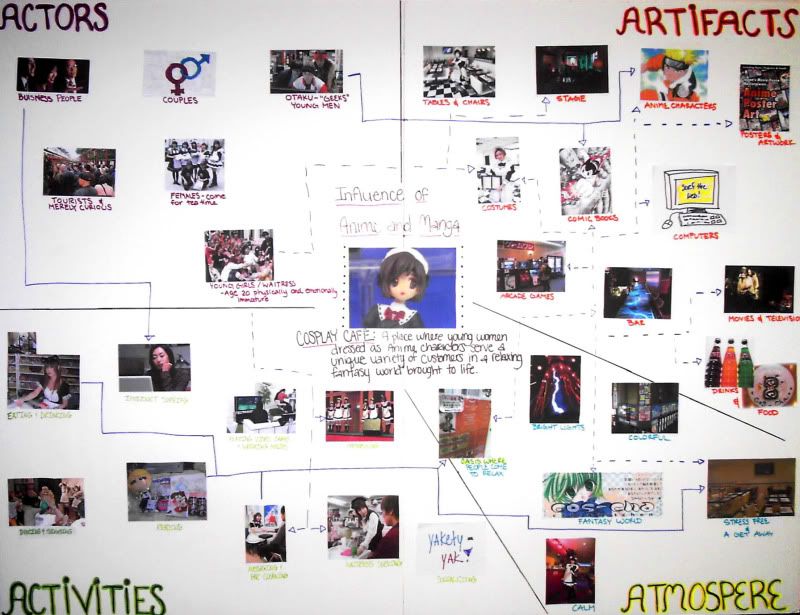

An example of a mind map I made at ASU with a friend.

Here is another, shorter, article about mind mapping, if you're interested.  I'd share a map I made for my novel, but it isn't as pretty, heh.  Like this one, from Wikipedia:
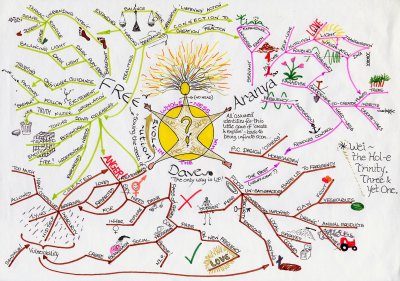

(By the way, your mind map doesn't necessarily have to be pretty.  It's just has to get your brain juices flowing.  I did my mind map for my story in black and white.)

Clustering is another technique I've used that's helped me understand my story a little better.  I just used it a few days ago to sort out all the prominent themes in my novel; I found there were eight. O_O (However, I also discovered that they were all connected to each other either directly or indirectly, which helps create a sense of unity, and they all could be linked directly back to one prominent theme: humanity, or human nature.)  I didn't use color in mine, but you can take a look at it:


I used solid lines to suggest direct relationships and dotted for indirect.  The "people/humanity" cluster had the most (all) solid line connections, which to me suggests it may be [edit: connected to] the central theme in my story.  I can use this knowledge now to help me assess whether or not my story reflects this then go back and "realign" sections where it does not.  Theme is a tricky element because sometimes you don't "see" it until you've finished writing most of, if not all of, your story.  However, it can be used to create focus, unity and cohesion.  (Funny--this is starting to sound a lot like the principles and elements of design.)

At first I tried everything because I didn't know what would work for me and what wouldn't, but eventually I found techniques that got results, so now I'm sticking to them.  And that's kinda what you have to do as a writer: figure it out.

"Ah-hyuk!  That's all, folks!"

Really, it is.  For now.  I've rambled on long enough.  Bless those souls who actually read both posts on this topic.  I really do hope you got something out of it.

On another note, I am interested to know what others do to help develop their story ideas.  Got any unusual or particularly effective brainstorming methods?

February 2, 2011

Links on Writing

Please scroll down if you'd like to skip my preamble and see all the links.

Let me just start off by saying that the Internet is an amazing tool.  It's ridiculous how much is out there nowadays.  Really.  (And it's free!)

Over the years I've done oodles of research into how to write a novel, a lot of it online.  I knew absolutely nothing starting off and wanted to learn as much as I could.  Along the way I kept track of all the useful websites I'd visited under my "Favorites" tab on Internet Explorer and I've been referring back to this collection of links ever since.

So, I figured, why not share the wealth?

If you're at all like me, having a voracious appetite for knowledge, then you might make great use of this resource.  Please do!  There are a lot of wonderful authors out there (like those listed on the right column of this blog) who have shared their knowledge via websites and blogs.  If it weren't for them, I'd know next to nothing about writing.

Below is an extensive list of links to articles about writing.  It is listed topically in alphabetical order (should be, anyway).  That way, if you have a particular interest in one aspect of writing you can just look under that topic and browse accordingly.  I plan on adding sites along the way if I come across new ones that I believe share information that might be helpful to fiction, particularly speculative fiction, writers.

Now, if you've taken a look at the list and already want to flee, I can recommend a few good sites for beginners (below) that go over the basics:

Larry Brooks does a great job of covering the basicswhat he calls the Six Core Competencies of writing: concept, character, theme, story structure (plot), scene construction and writing voiceon his website, and it isn't particularly focused on any one type of genre.  However, I do find his site a little difficult to navigate through at times.  Still, it would certainly be a good start content-wise.  Also, check out Holly Lisle's site for writers and Martha Well's list of links for beginners.  (Martha lists some good books on writing to check out or purchase, too, if you get the chance.)  Now, if you'd really like everything laid out in a straight line for you, then you should check out how-to-write-a-book-now.com because that's exactly what you'll get there.

Suite101 is another great free resource available to writers and has tons of articles written by professionals, not just on writing but on other topics like music, history and technology.

If anyone knows of any other links that would fit nicely on this list, do feel free to share and I will check it out and add it.  I'll be sure to make a list of names to thank and credit for any additions. :)


Helpful Links for Writers:

Action Scenes
  1. Action? Write spare to get the most. - Night Bazaar
  2. Thriller: Writing the Action Scene - FM Writers
  3. Writing Action Scenes - About.com
  4. Writing Action Scenes - Magical Worlds
Agents
  1. Agent Query
  2. Guest Blog: Ginger Clark on How to Handle an Offer of Representation - Nathan Bransford
  3. How to Find a Literary Agent - Nathan Bransford
  4. Publishers Marketplace (requires a monthly fee of $20 for access to some of the information, though not info on members--i.e. agents!)
Chapters
  1. Dividing a Novel into Chapters - Suite101 (I'm guessing chapters then to be a bit longer for fantasy and epic fantasy novels, but this article is still good reading, I think)
  2. How Long Should Your Story Be?  - Fiction Factor (general guidelines to go by)
  3. How to Write a Strong Novel Chapter - Suite101
Character Creation & Development
  1. Antagonist in Fiction: He Is Powerful - Writing.com
  2. Building Character(s) - Deep Genre
  3. Characterization - Writing Corner
  4. Choosing Your Main Character and His/Her Essential Counterpart - How to Write a Book Now
  5. Creating Archetypal Characters To Fill The Dramatic Functions in Your Novel - How to Write a Book Now
  6. Creating Memorable Villains: Four Steps to Creating Unforgettable Fictional Bad Guys - Suite101
  7. Creative Writing Tips - Have You Established Your Main Character At The Start? - Advancing Women
  8. Defining and Developing Your Anti-Hero - Writer's Digest
  9. Direct vs. Indirect Characterization - Fiction Factor
  10. Fiction Writing: Characters Rule the Story - Men With Pens
  11. Fiction Writing: What Makes Readers Care About Your Characters? - Men With Pens
  12. Holly Lisle's Create A Character Clinic (requires an online purchase for the PDF file, though is quite affordable at $9.95 and very informative)
  13. How to Create Characters That Are Believable and Memorable - How to Write a Book Now
  14. Kameron Hurley, Author of God's War, on "Bring Me Your Heroes" - Omnivoracious (Kameron Hurley talks about anti-heroes)
  15. Realistic, Engaging Characters in Fiction: How to Build Character in Novels and Short Stories - Suite 101
  16. The Other in Fiction: Creating Wonderfully Wicked Villains - Horror Factor
  17. The Story Crucible: The Factor that Keeps the Character in Trouble - Suite101
  18. Villains - Fiction Factor
  19. Villains vs. Antagonists - SF Novelists
  20. Ways Minor Characters Improve a Story - Suite101
  21. What Are You Talking About? write here, write now (a look at gender and archetypes)
  22. Writing Authentic Male Characters - Superhero Nation (being female, I found this useful)
  23. Writing the Male Character - Fierce Romance (generalizations, though again, probably most useful to females)
Climaxes
  1. Reaching Climax in a Novel Requires Planning - Suite101 (it really does)
  2. Rising to the Occasion: the Climax of Your Novel - SFWA
  3. Troubleshooting a Weak Climax in a Novel - Suite101
  4. Troubles With the Plot Climax - Finding Figments
Concept
  1. Concept Defined - Writer's Digest (Larry Brooks; really an excellent article; also addresses the terms "idea" and "premise")
  2. Using Concept To Focus The Story - The Visual Writer
Conflict
  1. Increase Character Conflict: Make Characters and the Story More Interesting By Increasing Conflict - Suite101
Dialogue/Dialog (they're the same thing)
  1. How to Write Dialogue in Fiction - Associated Content
  2. Writing Compelling Dialogue in Fiction - Suite101
  3. Writing Effective Dialog - The Writer's Ezine
  4. Writing Excuses 5.20: More Dialog Exercises - Writing Excuses (podcast - 24min.)
Editing & Revision
  1. Elements of a Novel: Editing - Musik Therapie
  2. One-Pass Manuscript Revision: From First Draft to Last in One Cycle - Holly Lisle
  3. Revision Technique - NaNoEdMo
Endings & Resolutions
  1. Creative Writing Ends With Conflict Resolution - Suite101
  2. Editing - Suite101 (lists a whole collection of topical articles on editing)
  3. Writing the Novel – Guidelines for Effective Endings - Suite101
Genre
(Not sure what genre(s) you write in?  Check out the "Genre Descriptions" article under All Genres.  Still confused?  Well, my friend, you might be writing cross-genre fiction.  Many folks out there would agree that some genre definitions are a bit...vague to begin with.  Do some research, read more in the field(s) you think your work fits in and maybe then you'll have a better idea of where your work fits it.  We fledgling writers will need to know this eventually anyway if we plan on getting our work published some day.)
Grammar
  1. Bold or Italics? - Artemy Lebedev
  2. Guide to Grammar & Writing - Capital Community College
  3. Handling Internal Dialogue in Fiction: Using Quotation Marks and Italics to Express a Character's Thoughts - Suite101
  4. How to Correct Run-On Sentences & Comma-Splices: Ways to Identify & Punctuate Using Semicolons, Conjunctions, Periods - Suite101
  5. How to Use a Colon and Semicolon - Suite101
  6. Hyphen everything2.com (who knew there were so many types!)
  7. Parentheses in Fiction - Crawford Killian 
  8. Passive Voice - unc.edu
  9. Punctuation Rules of English Ellipses and Braces - Suite101
  10. Semicolon Use - Suite101
  11. The Humble Hyphen - Punctuating With Hyphens, Em Dashes, and En Dashes Ezine @rticles
  12. The Proper Use of "Lay" and Lie" Grammar Tips (this eluded me for the longest time...)
  13. When and How to Use a Dash in Writing: Used to Interrupt, Introduce, Repeat, Separate & Clarify Sentences - Suite101
How to Get an Idea
  1. Novel Writing Ideas: How to Get Them - How to Write a Book Now
  2. Writing Excuses 5.10: John Brown and the Creative Process - Writing Excuses
Magic
  1. Sanderson's First Law - Brandon Sanderson
Manuscripts
(You'll find some variances, depending on your source, and the guidelines in these links are pretty much similar, but ultimately you'll want to go with the publisher's guidelines.)
  1. A Quick Guide to Manuscript Format - Writing World
  2. How to Format a Manuscript - Holly Lisle
  3. How to Format an Unpublished Novel in Word 2007 - eHow
  4. Manuscript 101–Introduction & Basic Manuscript Format - Kaye Dacus
Marketing Your Novel (or yourself)
  1. Carol Berg on Book Releases - Night Bazaar
  2. How to Create a Facebook Page in 3 Easy Steps - Author Tech Tips
  3. Your Blog as Stage: Building a Believable Author Brand - Storyfix
Novel Length
  1. Creative Writing: How Long Should Your Novel Be? - Ezine @rticles
  2. Uncle Orson's Writing Class: Novel Length - Orson Scott Card
  3. What Is the Ideal Novel Length? - Novel Writing Help
Organic Writing
  1. Organic Plotting - Jodi Henley
  2. Organic Writing (mind-mapping) - From the Crow's Nest
  3. SOLVED: The Outlining vs. Organic Writing Debate - write to done (Larry Brooks)
Outlining
  1. Holly Lisle's Novel-Writing School (yes, it's free)
  2. How To Create A Plot Outline In 8 Easy Steps - How to Write a Book Now
  3. Outlining Your Novel in Thirty Minutes - SFF Net
  4. Writing an Outline of Your Novel - How to Write a Book Now
Point of View (POV) & Perspective
  1. Multiple Points of View - Tara K. Harper
  2. Story Perspective - Storymind
Plot
  1. Conflict and Character within Story Structure: The Basic Three Act Structure - Musik Therapie
  2. Good Plots Take Time - Highlights Foundation
  3. How to Plot Your Novel - Spacejock
  4. Plot Development: Climax, Resolution, and Your Main Character - How to Write a Book Now
  5. Plots & Stories - Tameri
  6. Plot Versus Character: Which Drives the Story? - Hear Write Now
  7. STORY STRUCTURE: PART ONE (Asking the Right Questions) - SFF Net
  8. The "Basic" Plots in Literature - ipl2
  9. The Best Approach To Story Structure: From Aristotle to Dramatica - How to Write a Book Now (debatable, but still worth reading)
  10. The Story Goal: Your Key To Creating A Solid Plot Structure - How to Write a Book Now
  11. The Top Ten Plotting Problems - SFF Net
  12. Tips for Plotting: How to Create a Fascinating Plot for Your Story - Associated Content
  13. Writing Excuses Season Three Episode 12: Subplots - MBarker at Live Journal (transcript of a podcast discussion on subplots featuring fantasy author Brandon Sanderson; link to original podcast provided)
Plot Twists
  1. Playing it Straight With Plot Twists - Dave King Editorial Services
Prologues
  1. Pondering the Prologue: Should You Keep it or Kill it? - The Other Side of the Story
  2. Prologues – This Side of Hell - Behler Blog (from an editor's POV)
  3. The Prologue - When to Use One, How to Write One - Foremost Press
  4. Where to Begin? When, Where and How to Write a Prologue - Writing World
Publishing
  1. CompletelyNovel (a combination self-publisher/social network; read a review by Self-Publish Review here)
  2. Lulu: Self Publishing & Book Printing Solutions (a review from PCMag here)
  3. Publishers Marketplace (requires a monthly fee of $20 for access to some of the info)
  4. The Pros and Cons of Self Publishing - Suite101
  5. To POD or Not to POD? Some Pros and Cons - Writing World
Query Letters
  1. How to Write a Query - Agent Query
  2. Query Letter #... - Call My Agent (an Australian literary agent posts some examples of query letters and explains what works, what doesn't and why)
Scams
  1. Avoiding Writing Scams - Night Bazaar
  2. Warnings About the Schemes, Scams, and Pitfalls That Threaten Writers - SFWA
Scenes
  1. Scenes: The Building Blocks of Novels - Suite101
  2. The Essential Scene List - Kay Kenyon
  3. Writing in Scenes, Part 1 - Kay Kenyon
Short Stories
  1. Short Stories: 10 Tips for Creative Writers - Dennis G. Jerz
  2. Tips for Writing a Short Story - Write 101
Starting (& Finishing) a Novel
  1. How to Write a Novel - Justine Larbalestier
  2. How to Write a Novel (Part 1) - DeepGenre
  3. How to Write a Novel - Spacejock
  4. How to Write a Novel: The Snowflake Method - Advanced Fiction Writing (not recommended unless you have a clear vision of your novel before starting)
  5. Stages of a Novel: Writing the Rough Draft - Katie Ganshert
  6. The Tyranny of the First Draft - Karen Miller
  7. What Starts a Story? - Kay Kenyon
  8. Writing Your Books In Multiple Drafts - AutoCrit
Style & Prose
  1. Checklist: Elements of Literary Style - teachers.lakesideschool.org
  2. Passive Voice - unc.edu
  3. Send up the (Red) Flag: Words That Often Spell Trouble - The Other Side of the Story (gives some great examples of the problematic use of certain words)
  4. Style: the Rhythm of Prose - Fiction Factor
  5. Turkey City Lexicon – A Primer for SF Workshops - SFWA (meant for science fiction writers, though it has great pointers for writers in general; scroll down to "Part One: Words and Sentences" for the helpful stuff)
Synopses
  1. How to Write a Synopsis - Writing-World
  2. Mastering the Dreaded Synopsis - Condensing Your Novel - Fiction Factor
  3. Synopsis vs. Outline - Fiction Factor
  4. Trilogy Synopses - Fantasy Factor
Theme
  1. Choosing a Theme for Your Novel - How to Write a Book Now
  2. Does Your Fiction Novel Have a Theme? - Men With Pens (a guest post from Larry Brooks)
  3. Finding Your Themes - Holly Lisle
  4. The Elusive And Confounding Core Competency That Is “Theme” - Storyfix (Larry Brooks again!)
Writer's Block
  1. Plotters vs. Pantsers: How To Make Sure Writers Block Doesn't Kill Your Dream - How to Write a Book Now
Writer's Groups
  1. Writing Groups - The Writer Magazine
Worldbuilding & Setting
  1. A way with worlds: 14 - Creating new religions - SFF World (try to ignore the annoying ads)
  2. Choosing a Setting for Your Novel - How to Write a Book Now
  3. Creating Worlds, Part 1: Overview and Uniqueness - The Write Thing
  4. Fantasy Worldbuilding Questions - SFWA
  5. Holly Lisle's Create A Culture Clinic (requires an online purchase for the PDF file, though is quite affordable at $9.95 and very informative)
  6. Holly Lisle's Create A Language Clinic (requires an online purchase for the PDF file, though is quite affordable at $9.95 and very informative)
  7. How to Draw Nice Maps - Zompist
  8. On Religion in SF and Fantasy: An Interview with Orson Scott Card - Writing World
  9. The Mythopoet's Manual - Loren J. Miller
  10. Worldbuilder Questions - Lars Eighner (tip: try pressing Ctrl+A to highlight all text and make it stand out if it's too hard to make out on the graph paper background)
  11. Worldbuilding 201: Normalizing the Absurd - Kameron Hurley

Keep in mind, too, that some of these links cover multiple topics and some are even from the author links I've posted on this blog.

If you happen to visit one website and find yourself liking most of the content on it, then why not add them to your favorites?  I admit, I'm going to be putting up a ridiculous number of links and the thought of it overwhelms even me.  Having a resident go-to how-to site, if you will, that you feel most comfortable with is a lot less daunting than having a huge list in front of you.  (Though, I personally believe it's good to diversify and read from multiple sources, just to cross-reference information.)

Again, this is just a resource.  What one writer may find immensely helpful another may think is useless and utter crap.  I'm just putting it all out there because you never know what you might learn from someone else's perspective.

A Final Note

If there's one prominent thing I've learned in my experience so far, it's this: There is more than one way to write a novel or complete a story.  Lots of these links will suggest multiple strategies for achieving results, and not all of them may work for you.  As a new writer you will have to try different methods and learn what works best for you.  It can be a tedious, frustrating process, but I believe that the writer who knows himself well will have a better time of knowing what to write and how to write it.  Keep that in mind if you ever feel overwhelmed with your project because becoming a good (or rather a great) writer takes lots o' time.

I should know; I'm still trying to get there!

Welcome to My Blog!

Hello, there, and thanks for stopping by!  If you don't know me, my name is Tiyana and I've decided to start this blog for a few reasons:
  1. as a resource for other aspiring writers;
  2. to discuss writerly (yeah, I made that up) topics with like-minded individuals; and finally
  3. because I can!
I plan on adding lots of links that would be helpful to those looking to learn more about writing or honing their craft.  I am particularly interested in novel-writing in the fantasy and speculative fiction genres, though not all of what will be on my blog will be limited to novels or fantasy and spec fic.  Core storytelling principles and elements are the same no matter what kind of story you write!  Sure, there will be differences in content, style, and length, but I think you'll find the information on this site useful no matter what your interest in writing is.

Anyhow, that's all for now.  I can't wait to get all of those aforementioned links up and start posting some of my thoughts on writing for discussion.  I look forward to hearing from other writers/storytellers out there and learning from your experiences, as well.  Hopefully we can get a good community going here. :) (If not, it'll be just me talking to myself!  Haha.)

Until next time.

-Tiyana