Welcome to My Blog!

New readers can click here to learn more about the contents and mission of this blog.

March 17, 2011

Worldbuilding: Magic Systems


"Elemental Evolution" by bdotward.

This is part of an ongoing series about worldbuilding.

*     *     *

I have to be honest: I am running out of steam with this series.  So today, if you don't mind, I'm gonna be a little bit lazy.

If you're writing fantasy, read this article by Brandon Sanderson, if you haven't already.  I think it's the best I've come across on the topic of magic systems and will be basing the rest of this post off of it.

What kind of magic system(s) have you worked with?

I've been experimenting with what Brandon Sanderson calls a "middle ground" magic system, with an emphasis on the soft side.  There are no fancy spells or long drawn-out rules, though there is consistency.  There is some explanation as to how it all works, but I generally want it to be a mystery to readers.  An elementalist can only use their powers if their element is present in their surroundings.  (And in the case of fire-wielders, they must use matches or lighters to produce and work with a flame until they've become advanced enough to make things "spontaneously combust.")

However, because I'm using a "softer" system, I tend not to use magic to get my characters out of a tight fix, as Brandon's article talks about.  If they win a battle it isn't always because they were better elementalists.  It's usually because they were smarter about the way they used their abilities and/or their environment or had some other skill which gave them an edge.  (They aren't at all like your all-powerful Jedi Knights.  Well, with the exception of two secondary characters, but they're just extreme freaks of nature--exceptional elementalists at their prime.)  Maybe they even had the element of surprise.

(The biggest problems in Element 7 cannot be solved with magic anyway because they are problems of human nature.  The ability of those few who are able to manipulate the elements is one of the greatest problems in the first place.  How do you live in a world beside people with such an ability?  Could it ever be safe?)

These are the kind of things I like to consider before I decide to use magic.

How about you?  If you are writing fantasy, what kind of magic system do you use?
_____

March 16, 2011

Worldbuilding: Languages

This is part of an ongoing series about worldbuilding.

*     *     *

I think this is something I've always played around with as a kid.  I used to create interesting-looking writing characters and put them to the English alphabet.  Never did a whole lot with them, though.  (I did actually create a new font type using Fontifier once.  That was a lot of fun.)

But really, languages go waaaaay deeper than characters and alphabets, as I'm sure you can appreciate.

Confession!

I have a confession to make: I am a horrible citizen of the world.  I'll learn a new language, oh sure, but don't count on me to actually use it on a daily basis or, heaven bid, speak it fluently.  I took about four years of Spanish in high school, but I don't actually use it a whole lot now (except occassionally at work, when people are trying to figure out what stuff to buy; I can generally pick up what they're talking about and make recommendations for them).

What a waste, right?  Guess I'm just your typical American in that way, trying to earn some college credits to make life easier down the road.  I was an honors student (still am--magna cum laude, yo!); the GPA game, inevitably, took precedence.

It's just I've always been fascinated with people who can speak other languages; it's a mystery to me.  Though I don't think I've ever wanted to become one of those people (as stupid as this may sound) because then the mystery of it all would be gone.

Call it a silly form of idealism.

I don't know.  I think some people have a gift for speaking in different tongues and others don't.  (Excuses, right?)  But I don't think those four years and AP credits were a complete waste of my time.  In fact, it wasn't wasteful at all.

Building a Language (or two, or three, or...)

If you speak Spanish, then you already know that the syntax rules are a bit different from those in English.  For example, if you want to say "the fat cat" you wouldn't literally say "the fat cat;" you'd say "the cat fat" (el gato gordo).  Not to mention, words in Spanish actually have gender associations, so if you wanted to say "the fat girl," it wouldn't be la chica gordo but instead la chica gorda.  (But don't go spouting that one around!  "Ey, chica gorda--ven aquí!" *slap*)  Of course, there are always exceptions to the rules, further complicating things.

Anyways, I always thought this was interesting.

These two rules about Spanish are just the little, easy things to catch on to.  We haven't even brushed verb conjugation!  (Good lord.)  I can't properly imagine how languages like Japanese or Arabic might work, but I bet it'd be fun to learn (if only out of curiosity).  In any case, it's stuff like that which you can incorporate into your own make-believe languages to make them more life-like while sounding foreign to the English-speaker's ear.

There is an entire world of languages out there from which to derive inspiration and to serve as models for any languages you decide to create.  Even if you haven't taken lessons in another language, you can at least look up phonetics and phonology or listen to audio and video clips of people talking in tongues that are foreign to you.  Honestly, being a musician, a lot of times I just go by the general sound that I want a certain language to take on, and I only develop enough of it to get by.  (If I didn't, I would have never gotten around to writing the first draft in the first place!)

To create a new language, I would recommend getting a feel for the sound of it first by brainstorming sound combinations for words (which don't necessarily have to have meanings just yet but can later) then establish the alphabet and "rules" while developing a vocabulary that you think you'll want to use in your story as you go along.  Of course, you can get really in depth with this, but you don't have to because the rest, as they say, is just gravy.

An Example

So right now in Element 7 there are actually seven languages which are made reference to.  (And no, that was not an intentional allusion to the seven elements in the story, though now that I think about it... Hm, I could really do something with that!)  Anyhow, those languages are:

  1. Windi (which is just my name for English, because it wouldn't really make sense to use "English" in a make-believe world);
  2. Borellian (I use this one a lot, actually; it's modeled after Italian and French and was meant to be a bridge language between the ancient Nolians, who spoke Windi, and the Trysteese, who were displaced from their homeland into Nolian territory--which is why it's somewhat similar to Windi, or English);
  3. Heinu (only loosely developed at this stage; somewhat modeled after Japanese);
  4. Keshema (kind of inspired by Arabic, maybe?  Very loosely developed);
  5. Urzu (um...couldn't tell you what that's modeled after, though it's certainly not Urdu; I haven't used it much, at this stage);
  6. Qyowen (a weird mixture of Chinese maybe and early Mesoamerican languages, I suppose; it's considered an antiquated language, so I haven't used it extensively); and finally
  7. Trysteese (which originally was going to be modeled off of Greek, though it turned out to be something else; also considered an antiquated language).

*breathes*

Is it crazy that I've listed that many languages for one novel?  I hope not.  It's not like I've fully developed them all, either.  For most of them, I've just given them distinct names and only use a couple of words from each in my character's dialogue.  For some, it's mostly just been useful for coming up with city and region names.

But anyways, those are my languages.  I am by no means an expert in linguistics.  Not even close.  I just like making stuff up (or mixing stuff, as may be the case).

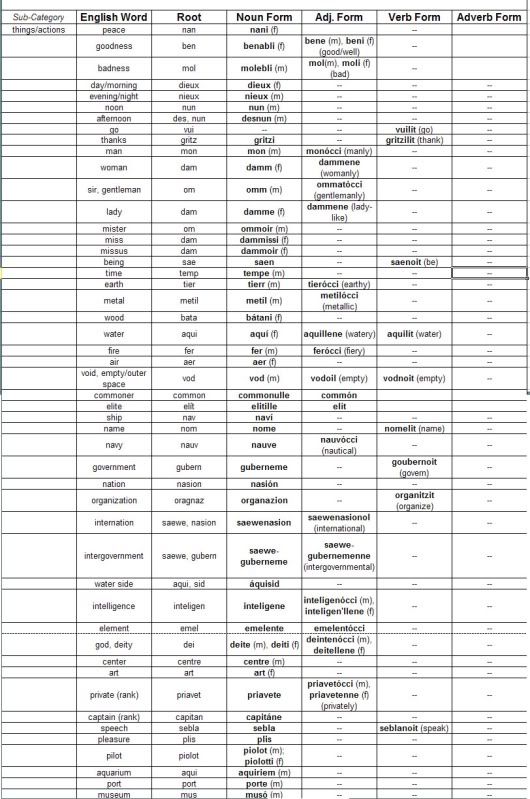
Here is a snapshot of an Excel table I've created using Holly Lisle's Language Clinic suggestions.  It helps me keep track of all the words and rules I develop along the way for Borellian (though, honestly, I sometimes just wing the rules or follow the ones used in Spanish, heh):


(Click it to see it full-size!)
  A few examples of sentences in Borellian might be:
  • Ah, e Dammissi Román--noittro piolotti nouva!  ("Ah, and Miss Román--our new pilot!")
  • Nes no saene viti dammene, no?  ("She isn't very lady-like, is she?")
  • Ouele, nes saelét cala fete fer tad tempe.  (Literally, "Yes, she has been like that for all time," or more simply, "Yes, she's always been that way.")

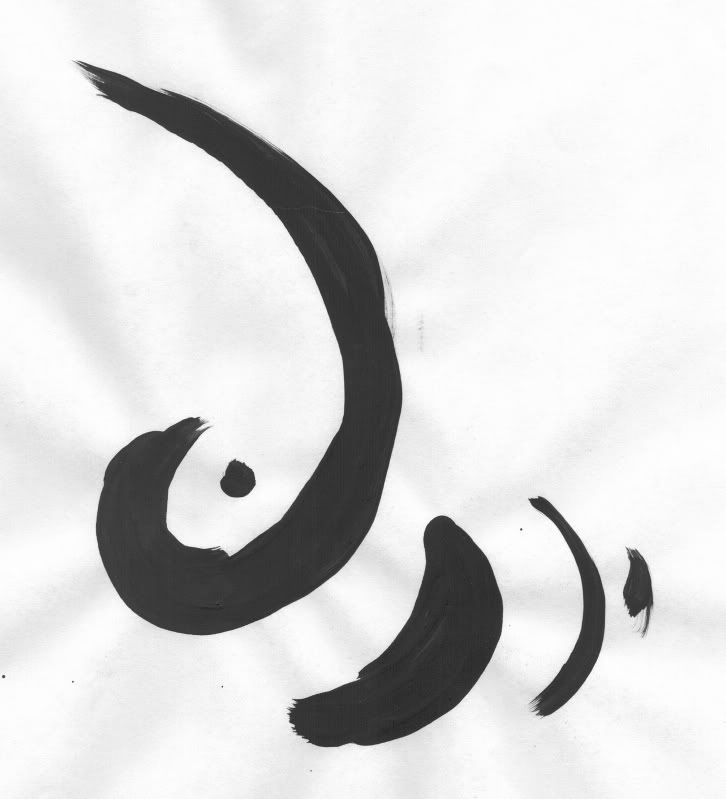
Random, I know.  Only the first one is in the story now.  And here's what Trysteese would look like if it was written out:


Voi's name in Trysteese, though it's spelled the approximated "Foi" since the letter V doesn't exist.

Why Use Languages At All?

I think the number one reason would be just to make any cultural differences between your characters stand out and feel more realistic--particularly if they are incumbent on the plot.

Language is important in my WIP because certain world events have happened to certain peoples, which makes them perceive things differently than their neighbors.  (Vague, I know.)  The idea of the seven elements is one of those things which is understood differently between cultures in Element 7, and this colors some of the world religions.  Also, the word emelesia, which is the condition Voi has, has its roots in both Borellian and its predecessor language Trysteese.  And since Voi is half-Borellian...

It's all very connected.  Let's just leave it at that.  (Element 7 has first and foremost been a labor of love, people.)

Also, you can have a bit of fun and create language tics which can effect people differently.  For example, urche, the medication Voi takes, is a Borellian word by origin and is pronounced "oor-keh" in that language, though Windi-speakers tend to pronounce it as "yerk."  This naturally annoys some Borellians to no end, as the two sound nothing alike; it entirely loses its Borellian flavor when pronounced the Windi way.  So sometimes I have one of my Windi-speaking characters use "yerk" to deliberately piss off a particularly annoying Borellian character.  (Voi's name is another one--"voy" versus "vwah.")

A minor thing, but I use it to build character.

Hey, what do you know?  My posts are still looking long!

Okay, so tomorrow I'll touch on magic systems.  (I know Brandon Sanderson wrote a good article on this somewhere...I'll have to find that.)

Qui aba vú?  "What about you?"

Okay, so that's not actually 100% original at all because qui actually means a few other things in French and other languages like Latin and Catalan (but I really, really love that word and kind of want people to be able to guess at the meaning anyway, so meh).  And according to Wiktionary, vu means "you" in Ido.  Though honestly, I didn't know about that last one.  (I just looked it up, heh.)  But aba doesn't appear to mean "about" in any language I have access to, so hurray for that, I suppose.

That's another thing you can do is Goggle the words you think you're inventing to see if they've already been invented.  It can be crushing. *sighs*

So how about you?  Have you tried your hand at creating a new language, or do you think it's just a waste of time?
_____

March 15, 2011

Worldbuilding: Setting & Maps

This is part of an ongoing series about worldbuilding.

*     *     *

Last time I gave you my personal definition of worldbuilding and mentioned that next I'd be talking about settings (among other things) and processes I've used to develop them.

All right, then so here it goes.

Settings

Before, I've talked about The Importance of Setting in a story.  Where do you get setting ideas?  Largely from the real world, I imagine.

I started off being inspired by how American and European cities might have looked and functioned during the mid-1930s/pre-WWII era, actually.  (I don't think this is an era that gets explored much in fantasy.)  I'm not writing about an alternate history, though, so this era only serves as an aesthetic and practical guide.  I was really inspired by artwork and photographs of actual places, as well.

Then I came up with some names for countries, brainstormed some general ideas about them and just flew off from there.  (Real helpful, huh?)  I'll explain more.

Map-Making

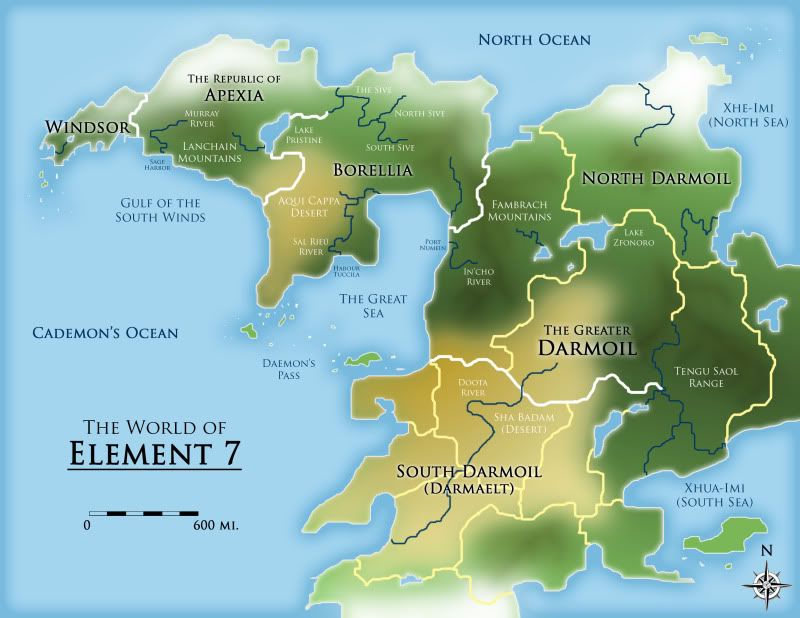
It has helped me immensely to keep track of locations by creating a map, so this might work best if I showed you a couple:


This one basically shows important geographical regions--deserts, rivers, mountain ranges, oceans, etc. in my WIP.  I used Adobe Photoshop to create most of it, though I used AutoCAD, a computer-aided drafting software program, to do the little scale.  (CAD is good for exact measurements 'n stuff.  I often use it to draft floor plans and other similar drawings.)

The compass, however, is not mine.  Honestly, I don't remember where I got it from.  (Does that make me a bad person?)  I could have made one in CAD, though.  Hm, guess I was just being lazy!


Same story for this one, only it focuses more on the city names and more clearly delineates the nations with color.  I separated these things from the geographical regions to keep it from getting too cluttered (though, this isn't all that necessary).

To tell you the truth, neither of these drawings is complete.  I really need to go back and update them with new references I've made in the story.  (I tend to keep a lot of info up in my noggin 'cause I don't wanna have to keep making corrections to everything when I change my mind.)  But still, it was a good starting point.  I know where everything is located and if I need to I can measure approximate distances.  This helps for calculating realistic traveling times, which is important, I think, when you're writing about an aviatrix--or train travel, or any other kind of travel, really.

(That's another thing I've had to do is research typical car and train speeds in the 20s and 30s.  Usually I just pick one car and train model, look up the specs and use those as a starting point.  Of course, it's all approximated.  I don't want to get too anal about that stuff.)

Gosh, I wish I could find that link that got me started on these maps!  Suffice it to say, it's a fairly detailed process that would not fit very well into a little blog post...

OMG!  NEWSFLASH: I FOUND the LINK!

So there ya go.  I would like to go back and try some new things I learned, to make the mountains pop out more, for example (that person's map on the link has way better mountains than I do), but that's something for another day.

What else can you use to draw maps if you don't have Adobe Photoshop?

Well, you can always draw it by hand.  Do a couple of drafts in pencil, trace over the final one with marker on vellum, trace or marker paper for the final version; splash some color on it here or there... (You cand do that on the back side of the paper so it won't bleed/smear with the marker, unless you do the marker last and just use pencil first.)  For color, I have these really awesome (though pricey) art markers by Chartpak that work a little like watercolors, the way the colors kind of spread.  Though, they smell really strong.  You can get a little high off of them.

...

I'm kidding, but they are very strong-smelling.

You could also leave it in black-and-white, which can make for a very graphic effect.  Using different line weights really adds dimension--if you're interested in the more artsy aspects, that is.

If not, that's cool, too.

Ultimately, though, I think maps should be used to help the writer visualize where everything in his story is taking place.  Doesn't matter if they're pretty or not, especially if they're only for you.

Setting As Character

As it has often been said, setting can become a kind of character itself in your story.

I've found this to be the case in Element 7.  The geographical features actually have a direct relationship to historical events which were initiated by certain characters way back when.  These events have effected the present-day geography.  For example, why do you think the deserts seem to fan out from Daemon's Pass, just southwest of the Great Sea where floats a collection of scattered islands?  And why is that region called "Daemon's Pass" anyway?

Hm... The world may never know.  (Especially if I don't finish editing this beast, heh.)

Finding Inspiration

I find that artwork provides a lot of inspiration for settings in my story.  They even give me some scene ideas.  Here's one that inspired my vision for Chandra City, Apexia (which is only labeled "Chandra" on my map, so I better fix that, too):

"Autumn's Glow," by Alexei Butirskiy

(This artist's work is so beautiful.  I'm inspired by most of it, actually.)

I imagine that the area my protagonist Voi lives in looks a lot like this.  She stays in a townhouse of yellow brick and light-colored stone in Chandra City on Blithe Street, where an electric trolley runs by.  Also, it's in the latter half of autumn at the beginning of the novel, so I like the image of there being golden leaves on the trees and sidewalks at this time.  This is exactly where Chapter 1 starts off--someplace peaceful to contrast the psychological horror of Voi's condition.

Her home is her refuge from the world.

In Chapter 1, she is experiencing...what I will call a "private state of heightened awareness" as she soaks in a clawfoot tub, avoiding her meds...just generally being a naughty emelesiac.  Kind of like this:


Original author unknown.
 (But trust me, it's not what you think.  Though, I certainly want you to believe it is.  I'm hoping that the intent behind this scene thrives off reader assumptions.  I'd like to share it sometime, once I've shopped it around a bit.)

Meh, I could mention something about Borellia, too, but you know how I am with words.  I will say, though, that the ancient ruins and antiquity of Italian cities have been a big inspiration for my vision of Borellia, as have French towns with half-timber structures from Medieval times.

And Airships.  You just have to have airships in a 1930s-inspired world.  (This was during the latter years of their Golden Age, after all.)

So that's kind of how I think about settings.  Next time: languages!  (Oh yes.)

How About You?

Do you like to use maps to aid with fleshing out your story?  If so, do you keep them pretty simple or like to deck them out?  Also, where do you tend to find inspiration for the settings in your storyworld(s)?
_____

March 14, 2011

A Little Advice?

Hey, peoples.  I was wondering if I could get your opinion on something.

I've been putting it off (my other versions weren't so great), but I finally wrote a presentable "blurb" for my WIP.  Got some perspective and came back to it.  So far it's the best I've managed to come up with.  Here's what I have:


Voi Román is in a pickle.  Suffering from a rare psychophysiological condition known as emelesia, she faces a grim fact of life: By her twenty-fifth birthday, the urche supplements she takes will not be enough to manage her condition; soon, she will need to be admitted to a mental asylum.  Well, she’s twenty-four and a half now, and to make matters worse, her aeroplane tour company, AeroTaxi, has undoubtedly seen better days.

Running on her last drop of optimism, a possible solution presents itself when a questionable government agent visits her home.  He claims there is a cure for her condition, though it comes with a price.  Work for us, and we’ll work with you, he promises.

Tentative at first, Voi embarks on a journey of self-discovery.  Before she knows it, she is swept up in a whirlwind of arcane occult practices, experimental aerocraft technology, aerial espionage, and international intrigue.  It’s enough to make a girl go mad.  Though, Voi’s sanity is not the only thing she risks losing…

It's at 169 words, which I hope isn't too long.  I've got a shorter version that's only a sentence long under my "Element 7" tab, and maybe that one could be a little shorter, too.  Not 100% sure of length guidelines.  (I've heard anywhere between 75 to 200 words for blurbs, at least.)  Anyways, I was hoping to put this one up there, as well, to give folks (and myself) a better idea of the story.  I hope that isn't too preemptive of me, considering I'm still in the editing process (halfway through now, not including rewrites). >_<

Any suggestions? :D

Worldbuilding

Photoshop'd two internet photos of Dubai, for fun.
This is the first in what will be a series of blog entries on the topic of worldbuilding.

*     *     *

You know, I have this horrible habit of typing W-O-L-R-D at the start of "worldbuilding."  It's annoying.  Does that ever happen to you?

What is worrrrldbuilding, exactly?

I'll give you a brief definition of what I think it is: Worldbuilding is simply the process of constructing (creating) and establishing the necessary background information for a story's world.  And what kind of background information is deemed necessary, you might ask?  Well, that would depend on what you are writing.

For me, I am working a story in a world that does not exist, so I did some extensive legwork on building that world before diving into it because I needed to figure out what the reality of this new world was like before trying to present it to a reader.  (This is probably one of the few smart things I did before jumping headfirst into my first novel, heh.)  I had to develop a thorough understanding of what made it different from our reality then figure out how to render this through storytelling.  Even after exploring the same world for years, I still feel like there's more left to discover--which is part of the reason why I want to write more than one book that takes place in it.

If I was writing historical fiction, though, I imagine my worldbuilding process might involve a lot more research on real-world locations and details and less pulling semi-original invented ideas out of my brain and making them happen.  I think there'd be less creativity going on with the worldbuilding and more trying to get the facts straight.  If I were writing fiction set in an alternate history, my worldbuilding process would probably float somewhere in the middle of these two methods.

In any case, research would still play a role, however large or small.

Worldbuilding As an Organic Process

Like achieving focus in one's story, I believe worldbuilding can take place in both the planning and implementation stages of writing a novel.  During the planning stage its all about the development of ideas; during the implementation, or writing stage it's about establishing, within the story itself, whichever details the writer feels are needed in order to best tell that story.

You can plan 'til your heart's content, but there are some things you just can't plan for.  They just come to you suddenly like a voice from heaven, imparting you with epiphanic artistic insight, and sometimes more like a freight train out of hell (or out of a certain dream sequence from Inception), derailing everything you thought you knew about a setting, demanding that you alter some minor (or major, yikes!) world detail to better fit the developing story.  And not all the stuff you meticulously plan out is going to make it into the novel anyway.   Still, it's good to know your story's environment and history before trying to render it and have your characters interact with it.

That's how I understand it.

So that was all the boring, establish-the-platform stuff.

Now, on to all the fun stuff.  (Note: I'm going to be writing this series in a way that a first-time writer might be able to follow, though I'm aware the majority of my readers have already gone through this process at least once.  Hopefully everyone can get something out of it, though.)

Where To Begin?

Wherever you want to, really.  I started off just journaling about locations I had in mind.  I also collected images and played around with Photoshop for a while (this was when I was first learning to use it) to come up with setting concepts, so that can help sometimes.  I haven't been able to visit all the locations I developed for my first novel, but I at least know they exist.  My characters sometimes make references to places I plan to take them to later on.

At one point I discovered an amazing author named Holly Lisle.  I have just gobbled up all the stuff she puts out there for writers.  I've actually only read one of her novels *guilt, guilt*, The Ruby Key (which was great fun, btw, and the cover art is just gorgeous; had it as a desktop wallpaper for a while), but that's beside the point.  The point is she gives some really helpful advice and offers some great tools that writers can use to help them develop their stories.

Check out her $10 clinics on building cultures and languages, easily downloadable as PDF files.  (She also offers some bundles, which can save you money if you decide to buy more than two or three.)  I've found these to be very useful, actually.  I printed them out and keep them in binders on some nearby shelves for easy reference.

Don't wanna spend any money?  Well, there's plenty of free stuff out there on the internet that covers worldbuilding.  Trust me.

There are a few aspects of worldbuilding I've enjoyed more than others--those being languages, institutions and organizations, magic systems (I don't actually use the word "magic" at all in my fantasy novel, just "elementalism") and locales/settings, so I plan on talking about the processes I've used to develop some of those areas.  Maybe you've used/will use similar processes.  Maybe yours are radically different!

How would you define worldbuilding?

You can find a lot of definitions of worldbuilding on the internet, but I'm more interested in what the term means to you, fellow writers.  Maybe you'd disagree with how I've defined worldbuilding.  Maybe it's too simplified or general.  Perhaps there is even more to it.

So, what are your thoughts about worldbuilding?  What is it?  What is it not?  Is worldbuilding something that every fiction writer should consider doing before writing a novel?

And also, how much detail is too much detail?  How much is not enough?

(Feel free to pick and choose what you want to answer, as always.  I'm just throwing stuff out there.)
_____